Do Wine Glasses Matter
I went into Morrisons today and spotted something I absolutely didn’t need, but at this price there was no chance I was leaving them behind. A pair of Spiegelau Capri red wine glasses. £2.69. Admittedly, that was using 30 of the Morrisons stamps, but still. Two proper Spiegelau glasses for less than the price of…
I went into Morrisons today and spotted something I absolutely didn’t need, but at this price there was no chance I was leaving them behind.
A pair of Spiegelau Capri red wine glasses.
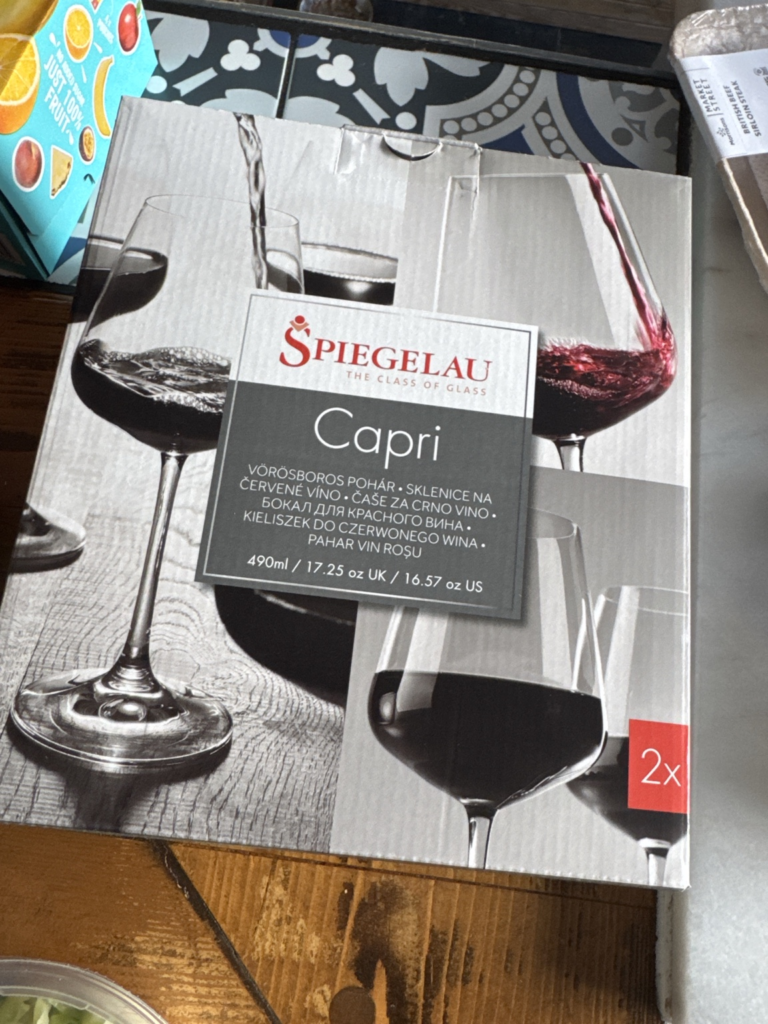
£2.69.
Admittedly, that was using 30 of the Morrisons stamps, but still. Two proper Spiegelau glasses for less than the price of a coffee feels slightly ridiculous.
And after getting them home, it got me thinking about something I’ve probably overlooked slightly on this whole wine journey.
How much does the glass actually matter?
It’s Not Just About the Wine
I’ve become increasingly obsessive about the little things with wine.
Serving temperature matters. Decanting matters. Giving a wine enough air can completely change it. I’ve had wines recently where the first glass and the last glass could almost have come from different bottles.
But glassware is something I’ve never really concentrated on to the same extent.
I’ve obviously always known that different glasses exist for different wines. Bordeaux glasses, Burgundy glasses, Champagne flutes and all the rest of it. But part of me has always wondered how much of that is genuinely improving the wine and how much is just another rabbit hole for wine people to disappear down.
Then I picked these up.
The First Thing I Noticed Wasn’t Even the Wine
It was the rim.
These Spiegelau glasses are noticeably thinner around the rim than the everyday glasses I’ve used plenty of times before, and it sounds like such a tiny thing, but it changes the experience immediately.
There’s less glass between you and the wine.
When you take a sip, you don’t have that thick rounded edge against your lip. The glass almost disappears and the wine seems to flow much more naturally onto the palate.
I’m not going to pretend that suddenly makes a £7 bottle taste like Lafite, because it obviously doesn’t. But it absolutely makes drinking the wine feel better.
And I think that’s an important distinction.
Sometimes we’re so focused on whether something changes the actual flavour of the wine that we forget drinking wine is an experience as well.
Then There’s the Clink
This might sound even more ridiculous, but the sound matters.
That proper little crystal like clink when two thinner glasses touch is just infinitely more satisfying than the dull knock you get from thick, heavy everyday glassware.
Does that change the acidity?
No.
Does it soften the tannins?
Of course not.
But does it make sitting down with a bottle of wine feel that little bit more special?
Absolutely.
There’s something elegant about the weight of the glass, the thin rim and that clean sound when the glasses touch. Even before you’ve properly assessed what’s in the glass, the whole experience has been elevated slightly.
Maybe some of that is psychological, but I’m increasingly wondering whether that really matters.
Wine is supposed to be enjoyed.
So Does a Better Glass Make Wine Taste Better?
This is the bit I want to test properly.
Rather than just convincing myself that my bargain Spiegelau glasses have transformed everything, I’m going to pour the same wine into one of these and one of my normal everyday glasses.
Same bottle. Same temperature. Same amount of wine.
Then I’ll see what actually happens.
I’m particularly interested in the nose. The Capri has a reasonably generous 490ml bowl, so there’s plenty of room to swirl the wine and hopefully concentrate some of those aromas.
Will I genuinely smell more?
Will the thinner rim change how the wine feels across the palate?
Or will I discover that I’ve just bought two very nice glasses for £2.69 and talked myself into believing they make everything taste better?
Either way, I’m interested to find out.
£2.69 Well Spent
Even before doing the proper comparison, though, I already think they were worth buying.
Not because they’re magically going to improve the liquid inside them, but because they improve the ritual around it.
The thinness of the rim. The weight in the hand. The larger bowl. That satisfying clink.
They’re all tiny details, but put them together and opening a bottle somehow feels that little bit more considered.
And that’s something I’m beginning to understand more and more as I get deeper into wine.
The bottle is obviously the most important part.
But perhaps the experience around the bottle matters more than I thought.
For £2.69, I’m quite happy to find out.